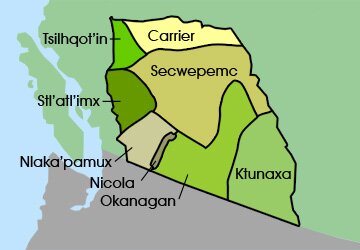
| Tsilhqot'in |
| Name |
Formerly the Chilcotin (an english rendering of Tsilhqot'in), their name means "people of the Chilcotin River". |
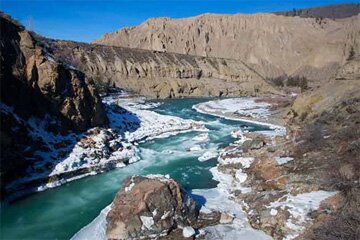
Chilcotin River |
| Location |
They lived in the northwestern region of the Plateau, along the west side of the Fraser River. |
| Language |
Athapascan |
|
| Carrier |
| Name |
Their name comes from a custom the people followed of widows carrying the ashes of their deceased husbands in a bag for a year. |
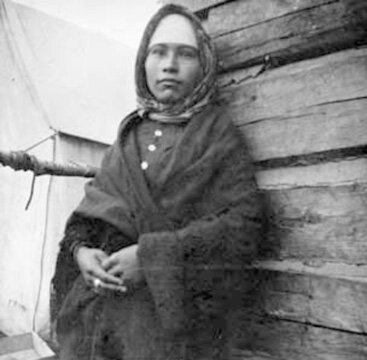
Carrier woman |
| Location |
They inhabited the central interior of B.C., the northern region of the Plateau. |
| Language |
Athapascan |
|
| Nicola |
| Name |
Their name for themselves is unknown, due to the extinction of their language. The term "Nicola" is incorrect in describing their people since it refers to a Secwepemc chief who once held power in the Nicola Valley. The Nlaka'pamux called them "Stuwix" to distinguish them from others in the Nicola Valley. |
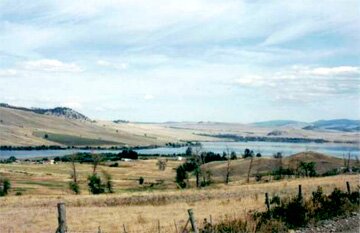
Nicola Valley |
| Location |
They lived in the Nicola Valley of B.C. |
| Language |
Athapascan language - their Athapascan dialect is now extinct. They have largely been absorbed into the Okanagan and Nlaka'pamux people. |
|
| Secwepemc |
| Name |
They were formerly called the Shuswap, which is an anglicized version of their name. |
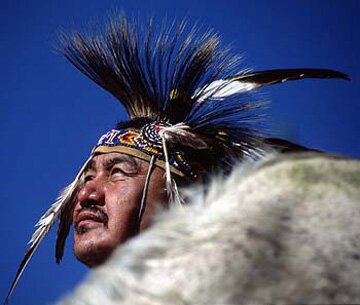
Secwepemc man |
| Location |
The two Northern Interior Salish groups lived in an area that stretched from the Rocky Mountains to the Fraser River. The Secwepemc lived north and east of Kamloops, B.C. |
| Language |
Interior Salishan |
|
| Stl'atl'imx |
| Name |
They were formerly known as Lillooet, which means "wild onion". Lillooet is actually the name of one of their former settlements. They are known as the Stl'atl'imx to the Secwepemc and Nlaka'pamux. (There are many anglised versions of the name "Stl'atl'imx", including "Stlatlimuq" and "St'at'imc"). They have no name for themselves. |
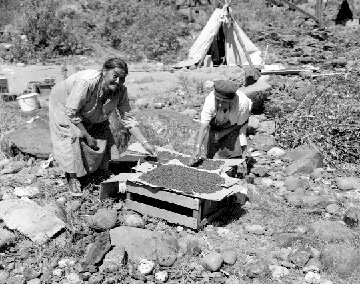
Stl'atl'imx women drying berries |
| Location |
The two Northern Interior Salish groups lived in an area that stretched from the Rocky Mountains to the Fraser River. The Stl'atl'imx lived in the western portion of the Plateau region. |
| Language |
Interior Salishan |
|
| Okanagan |
| Location |
These two southern Interior Salish groups lived in the southern interior area of British Columbia, and stretched down into Washington State. The Okanagan lived in the Okanagan Valley, from head of Okanagan Lake to the lake's confluence with the Columbia River. |
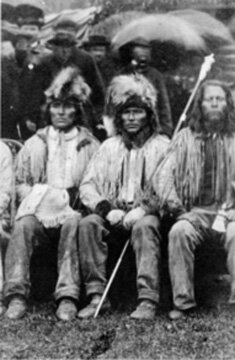
Okanagan Indian elders |
| Language |
Interior Salishan |
|
| Nlaka'pamux |
| Name |
They were formerly known as the Thompson, referring to the river that runs through their territory. |
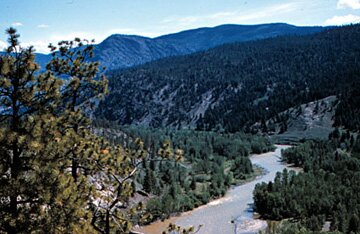
Thompson River |
| Location |
These two southern Interior Salish groups lived in the southern interior area of British Columbia, and stretched down into Washington State. The Nlaka'pamux lived in southern B.C. and northern Washington state, along the Thompson River. |
| Language |
Interior Salishan |
|
| Ktunaxa |
| Name |
Ktunaxa is an anglised word of the name they call themselves. They were formerly known as Kutenai or Kootenay, which is a corrupted anglised version of their name. |
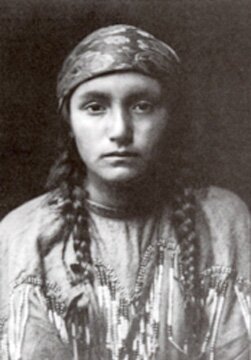
Ktunaxa girl |
| Location |
The Ktunaxa were a unique group who lived along the Kootenay River in southeastern British Columbia, into Alberta, Idaho, and Montana. Since they lived in the eastern portion of the Plains, they often crossed the Rockies to hunt buffalo. In many aspects, the Ktunaxa people were more similar to the Plains people than the other Plateau people. There is historical evidence suggesting that they were originally living in the Plains area and were driven into the mountains by the Blackfeet. |
| Language |
Ktunaxa - The Ktunaxa spoke a language that was unrelated to any other First Peoples group in Canada. |
|