











| treaties & change | |
| Treaties & Alliances Before European Contact | |
|
The First Peoples had many treaties between nations, recorded orally. |
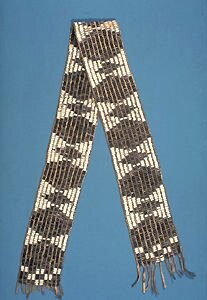 The Wampum Belt, a form of recording treaties for First Nations |
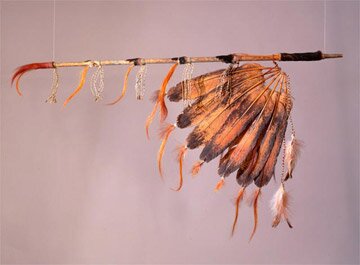 Peace Pipes, or Calumets, were smoked at the beginning of a treaty session |
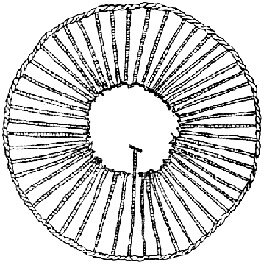 The Wampum belt from the Great Law of Peace; the fifty strings represented the fifty chiefs of the treaty |
| Early Military Alliances Between Europeans and First Peoples | |
| 1600s The French and Hurons | 1600s The British & the Iroquois |
| Soon after Champlain formed New France, French colonists became allies of the Huron Indians. Many Hurons converted to Catholicism. They were the primary group to trade with the French and controlled much of the trade between the French and other First Nations groups. The new European weapons gave the Hurons power to defeat the Iroquois, and push them off their agricultural lands. The Iroquois became allies of the Dutch who introduced guns into the different Iroquois tribes. Wanting their old land back, the Iroquois underwent guerilla warfare, spying on the nations south of Lake Ontario, and becoming a threat to the Huron Indians. The French, loyal to their alliances with the Hurons and also aware of the impact of Iroquois takeover of New France territory, fought the Iroquois until about 1703. |
The British settled their first colony in Virginia and as their colonies grew, they became allies of the Iroquois who lived in the surrounding areas. The Iroquois became trading partners of the British, as well as their military allies and supported them in their rivalry with the French over fur trading territory. The weapons that the Iroquois purchased from the British with furs allowed them to make war on the French and the Hurons. The Iroquois eventually almost wiped out the Hurons in what is now Ontario. Thus, the military alliances and trading partnerships of First Nations people and Europeans had a tremendous impact on political and economic life of both the First Nations groups, and the European newcomers to North America. |
| 1600s The Covenant Chain | |
|
At the end of the 1600s, American colonies and the Haudonosaunee entered into a series of treaties concerning the colony of New York and Iroquois confederacy land. |
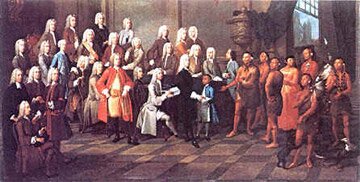 Parties gather in Albany, to forge the Covenant Chain Treaty |
| The Great Peace of 1701 | |
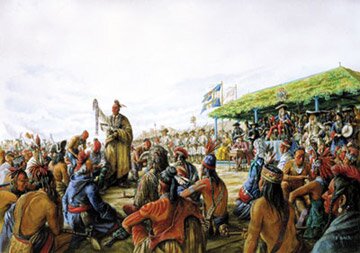 Native leaders gather in 1701 in Montreal |
In August, 1701, representative from more than 20 Anishnaabe nations assembled in Montreal for Peace negotiations sponsored by the French Governor Calliere. The Hurons & Iroquois promised to live in peace. The chiefs signed with totemic marks -images of animals and birds. The totem denotes the family or clan. In return, the settlers readily supplied First Nations peoples with trade goods like blankets, guns, and pots. |
| 1700s The Peace and Friendship Treaties | |
|
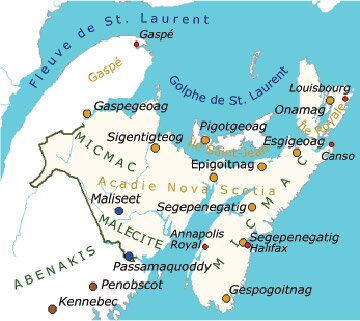
These were treaties between the British Crown and the Eastern nations the Micmac and the Maliseet, promising peace and friendship in the foundation of their relations. The first was signed in 1725, and was called the Boston Treaty, while the second, signed in 1752, was referred to as the Halifax treaty. The Halifax treaty guaranteed first nations rights to trade, fish and hunt, while receiving additional supplies from the Crown in the form of food, ammunition and provisions. |
 |
| Back to the Top | |
| Copyright Goldi Productions Ltd. 2007 | |
|