











| treaties & change | |
| British Relations With First Peoples After 1763 | |
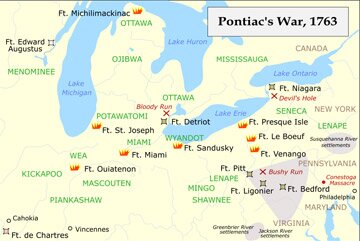
| The Pontiac Rebellions | |
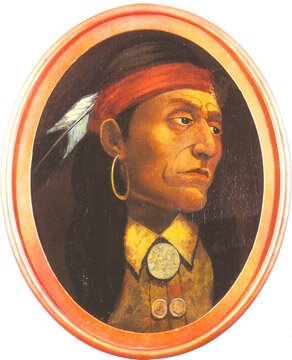 While there is no official document of how Pontiac looked, this is how 19th century painter Stanley imagined him |
When Britain took over French territories at the close of the Seven Years war, several Native Indian nations were upset. The Ottawas, Ojibwas, Potawatomis and Hurons were all allies of the French and not in favour of the new British rule. |
 |
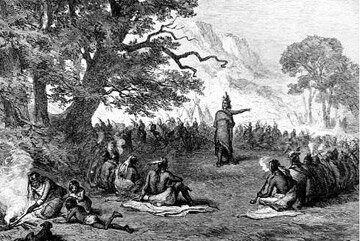 Pontiac urges others to rise up against the British |
| The Niagara Treaty of 1764 | 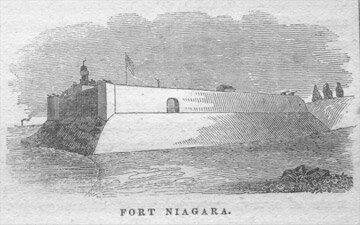 Old Fort Niagara, the location of the Niagara treaty signing |
|
Representing the crown, William Johnson met with 24 nations, and over 2000 people, and reaffirmed relations and peace between the British, and the Iroquois, the Algonquians, and the Hurons. The twenty-four nations wampum belt was made, showing twenty-four persons holding hands from a rock to a ship, which represented Britain. In the Niagara Treaty of 1764,, the crown promised to give gifts each year to the nations. |
|
| For Stanwix Treaty of 1768 | |
|
A treaty signed at Fort Stanwix in 1768, was the frist major transfer of land after the Royal Proclamation of 1763. It pushed the boundary separating colonial lands from Indian lands, as laid out in the Proclamation, much further west to the Ohio River. The treaty came about because settlers were suing the British government for attacks on them and damges suffered during the uprisings during the Pontiac Rebellions. (see above) The British government hoped a new boundary line might bring an end to the continual frontier violence between new settlers and Native Peoples.. The Iroquois hoped a new permanent line might hold back British colonial expansion. The treaty was negotiated between a representative of the Crown, and the Six Nations (the Iroquois), who received £10,460 7s. 3d. sterling. The Iroquois ceded the Kentucky portion of the Colony of Virginia to the British. However, the Iroquis, who signed away the land, were not the people who were actually using that land. The Shawnee, Delaware and Cherokee, who were actually using the ceded land, had no role in the negotiation Those rewarded from the treaty were mainly Iroquois friends of William Johnson, Head of the Indian Department. Their own land remained untouched. |
Rather than secure peace, the Fort Stanwix treaty of 1768 led to a new round of hostilities along the Ohio River. The Iroquois had actually negotiated away land that did not belong to them. This kind of situation would arise many more times in the future, and would eventually lead to modern land claims brought before the courts claiming that treaties were invalid, because the people who signed certain treaties had no authority to do so. The treaty signed at Fort Stanwix did not prevent the westward movement of settlers onto land that was supposedly to belong to Native Peoples forever. |
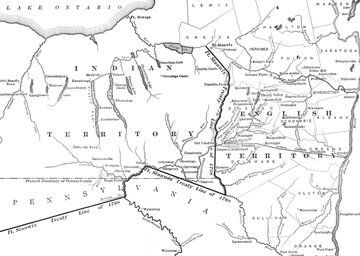 Land divided by the Fort Stanwix Treaty Land divided by the Fort Stanwix Treaty |
|
| The Quebec Act of 1774 | 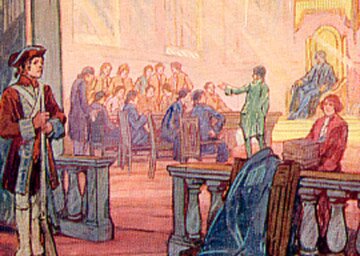 First meeting of council, following the Quebec Act (by Simpson) |
|
The success of the Fort Stanwix treaty from the settler's standpoint encouraged others to try extracting land from First Nations peoples. Some argued that agreements between nations and private contractors were legitimate enough, thereby vilating the Royal Proclamation. However, in 1774 the Crown officiated the Quebec Act, which in addition to declaring the boundaries of Quebec and allowing the practice of Catholic faith, reinforced allegiance to England and its law. In the shadow of the forthcoming American Revolution, this both allied the French and the English and neutralized First Nations people, who were upset with the land assaults by private contractors. |
|
| Back to the Top | |
| Copyright Goldi Productions Ltd. 2007 | |
|