| the story of white cap | ||||||||||||
| Escape from America | ||||||||||||
|
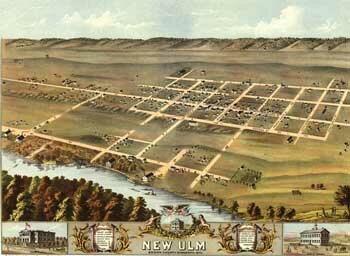
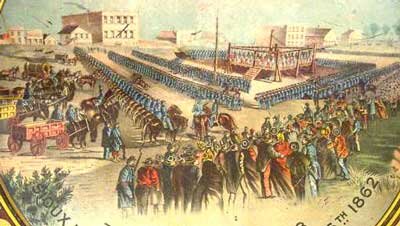
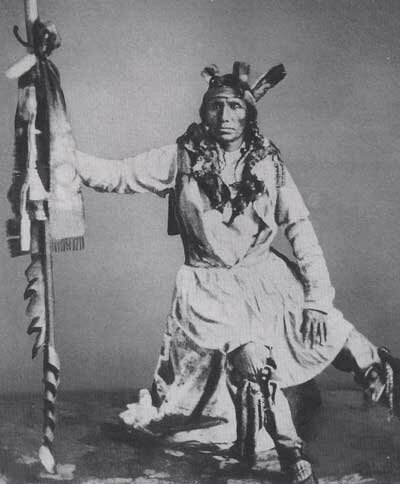
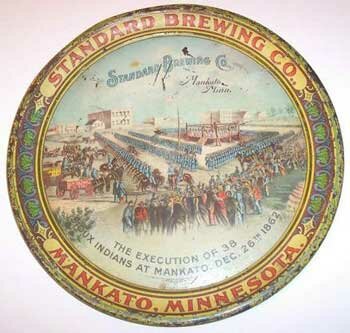
The Story of White Cap: White Cap was chief of a group of American Dakota Santee Sioux who had fled to Canada for safety during the bloody wars between Whites and Indians, in Minnsesota, in 1862. From time immemorial, the Dakota Sioux had roamed over thousands of miles of open prairie in the north central part of the United States. Then, in the middle of the 19th century, came the white miners, and the settlers, to elbow the Indians out of the way, using the guns of the United States Army to support them. The homelands and traditional rights of the Dakota Sioux shrank rapidly under the onslaught of White immigrants. In 1862 White Cap's tribe was part of a Sioux uprising in Minnesota. Racial tensions exploded in Minnesota, when a couple of young Indian hotheads shot a few settlers at a remote farm. A Sioux Chief, Little Crow, knowing the repercussians that would follow, led a pre-emptive Indian uprising. Over a period of four weeks, as many as 800 Whites were killed, as well as 60 Sioux. Until Sept. 11, 2001, it was the largest loss of civilian life during a war, in American history. The US Army, and winter starvation, ended the rebellion in a few weeks. White Cap and Little Crow fled, north to Canada, taking their tribe to Fort Garry, thereby escaping the largest mass hanging in US history, at Mankato, MN, when 38 Sioux warriors were hanged in a group for their part in the rebellion. The occasion was commemorated in this fabulous serving tin made by a local brewery.
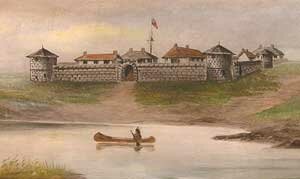
Little Crow, and White Cap, and their tribesmen, camped outside Fort Garry, afraid to return home. |
|||||||||||
|
||||||||||||
|
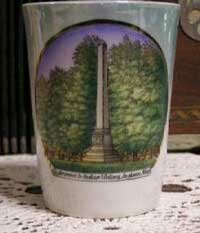
Two early 19th century souvenir cups feature the Indian Massacre Monuments erected in New Ulm and Jackson, Minnesota, on behalf of the white victims.
|
||||||||||||
|
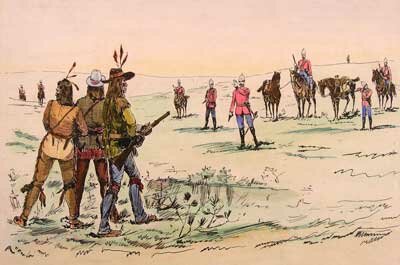
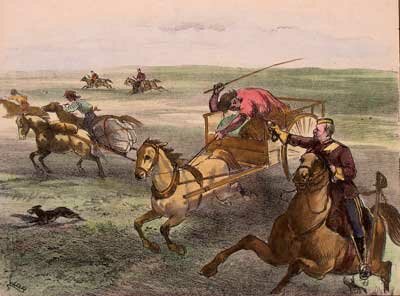
White Cap moved to Saskatchewan. Neither he nor his people wanted any part of violence. When the Riel Rebellion broke out they refused all entreaties to join the rebels in their fight against the Government troops. In the end White Cap was left little choice. He was forced to come "on side." When the battles were lost, White Cap and his people fled. They knew very well what vengeful white soldiers would do to Indians. Mankato was on their minds. Two of the lithos deal with the capture of White Cap and his people. |
||||||||||||
|
||||||||||||
| Back to the Top | ||||||||||||
| Copyright Goldi Productions Ltd. 2007 | ||||||||||||
|
 Great Canadian Heritage Treasure