











| The end of the rebellion | |||||||||||||
| The Métis Dispersed; the Leaders Punished | |||||||||||||
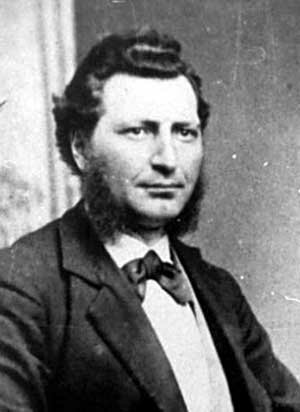
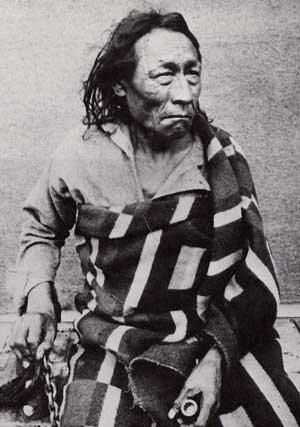
The End of the RebellionGabriel Dumont fled to the United States. Louis Riel surrendered. Later Poundmaker and Big Bear also surrendered. Nearly one hundred people were arrested after the rebellion. About 70 were convicted on charges from treason to theft. Big Bear and Poundmaker each received a three-year sentence, but both were released before the end of their sentences. Both men died within a year of their release. Riel was charged with six counts of treason. The government claimed that he "did maliciously and traitorously attempt and endeavor by force and arms to subvert and destroy the constitution and government of this realm." On July 6, 1885, Riel was charged with high treason. The Trial of Louis Riel
The trial opened on July 20, with Riel pleading not guilty. The jury was entirely Anglo-Saxon and Protestant. Riel's lawyer wanted to plead that Riel was insane and not responsible for his acts. Riel was so opposed to this strategy that his lawyers had the judge rule that he did not have permission to speak. The lawyers were not allowed to speak of the grievances which had led to the rebellion, as the judge declared that it was Riel, not the Government of Canada, who was on trial. The witnesses' insisted that Riel had been mentally unstable before and during the rebellion. Towards the end of the trial, Riel was allowed to speak. After a moment of prayer, he reviewed the troubles in the North-West, beginning with the sufferings his people had endured and the government's inactivity. He maintained with dignity that he was not insane and that he did not want to be acquitted by reason of insanity. Riel was sentenced to hang. The appeals went on for several months, but the date of execution was set for November 16. During the night of the 15th and the early hours of the 16th, he wrote one last letter to his mother and received the last rites. At 8:00 a.m., he climbed the stairs to the scaffold for his execution. His body was buried in the St. Boniface Cathedral churchyard. Many French Canadians in Quebec were outraged, and took the hanging as an affront to their people. It cast a shadow over English-French relations in Canada for decades. Today Louis Riel is regarded as the founder of the Province of Manitoba and defender of the rights of the Métis and of French Canadians. Indeed, of all Canadians... But for generations of Métis it was to be the darkest hours of their entire lives as a people: their property stolen, their lands taken, their houses burned. Hundreds had to flee for their lives, to, of all places, the United States which had an even worse record of human rights violation of native peoples. |
|
||||||||||||
|
The Return of the Volunteers: The Toronto Lithographing Company and Grip were so pleased with the response to their battle series that they issued a wonderful lithograph showing the joyous reception the men received when they got home after having put "Riel in his place." This lithograph is extremely difficult to find today in any condition.
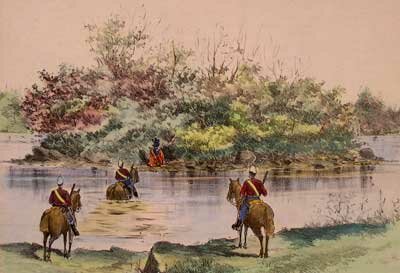
The popularity of the battle prints was so great that today - some 120 years later - it is still possible to find original prints at auction, sometimes with original glass and frame intact. |
|||||||||||||
| Back to the Top | |||||||||||||
| Copyright Goldi Productions Ltd. 2007 | |||||||||||||
|
 Great Canadian Heritage Treasure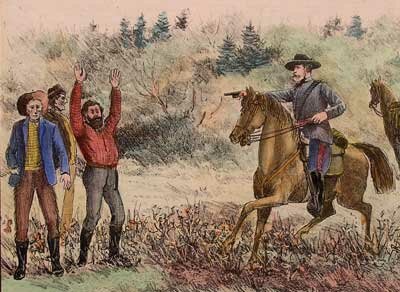
 Go to The Volunteers Return