| the mÉTIS | ||||
| Origins of the Métis Nation | ||||
|
The Métis are a distinct group of Canadian people who developed a unique culture that grew out of Canada's fur trade heritage. The Métis are descendants of French Canadians involved in the fur trade, and First Nations people. The roots of the Métis go back to the first French explorers who penetrated to the interior of Canada, where Canada's Aboriginal People had been living for thousands of years. French Canadian fur traders married and co-habited with Native women. Their offspring became known as Métis, people of mixed blood. They developed a proud culture, with elements of both people from whom they descended. |
 |
|||
| Voyageurs & Coureurs-des-bois | ||||
|
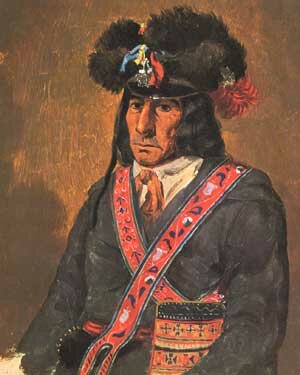
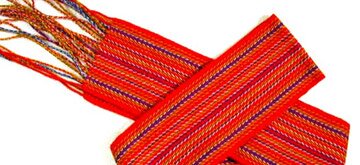
French Canadian Voyageurs were the main labour force for the fur trade of New France. They paddled the canoes, and carried the supplies and fur bales over the portages for the fur trading companies. When the French king made laws forbidding trading by anyone except the monopoly company, many young men broke the law, and moved out into the wilds to trade for furs. They became known as coureurs-des-bois (runners in the woods), running, as it were, from the enforcers of the law protecting monopolies. The French Canadian coureurs-des-bois and voyageurs became known for their distinctive style of dress. A blue capote, a beaded pipe bag hung from a bright red sash, beaded moccasins and the inevitable pipe became standard items. The distinctive Métis sash, wrapped around the middle, could be used as a belt, a tow rope, or a fastening line. |
||||
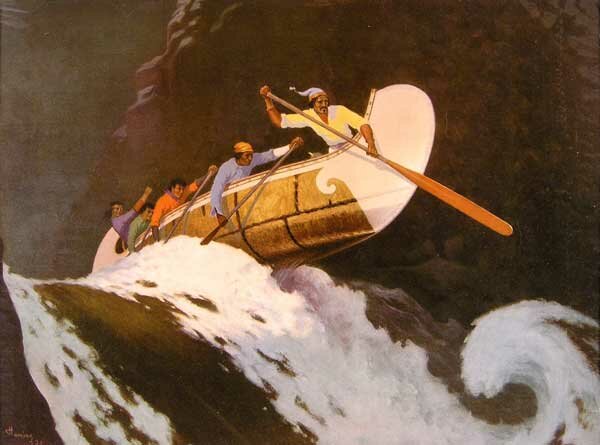 Riding the Rapids, Arthur Heming |
||||
|
They paddled upstream from Montreal to the Great Lakes and the Mississippi. There were many rapids that only a light canoe could cross, and many portages where the canoe had to be unloaded, goods and canoe hauled overland, then reloaded to continue the trip. Voyageurs worked sixteen to eighteen hours a day, paddling the canoes loaded with trade goods through fast-flowing waterways. It was hard work. Their day began at 2:00 a.m., with a six-hour paddle until breakfast. Lunch was pemmican eaten in the canoe. Once every hour, paddling ceased and each man lit his pipe. They stopped for a smoke every 6 or 8 kilometers, so the routes were measured in "pipes". Paddling continued until well after dusk; when they made camp and ate supper. Europeans traveling in the wilds had to create alliances with First Nations people who knew and controlled the waterways and transportation routes. The coureurs-des-bois needed Indian women to cook, prepare their food supplies for winter, make and repair their clothes, heal their wounds, and especially to make their moccasins and snowshoes, which were essential for travel. Some of these relationships created new family groupings. The children of these unions between French Canadians, and their First Nations wives eventually became the Métis Nation of Canada. Métis comes from a French word meaning mixed. |
 |
|||
| The Métis Nation: A Distinct Way of Life | ||||
|
The name Métis is used today by the mixed-blood people of French Canadian and First Nations ancestry, who settled in what is now Manitoba, and later in Saskatchewan and Alberta. By 1800, Métis were established as a distinct cultural group on the prairies. They worked for both the Hudson's Bay Company & Northwest Company as voyageurs, buffalo hunters, and traders. They settled along the Red & Assiniboine Rivers on long, narrow lots fronting on the river in the French Canadian style. |
||||
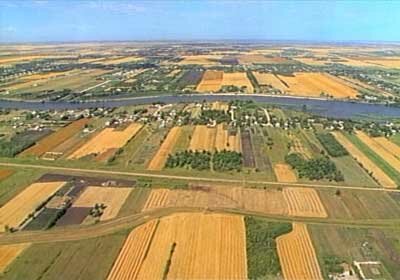 Classic Red River Métis strip farms north of Winnipeg, Manitoba The first farmland in western Canada |
||||
|
The Métis lifestyle reflected the mixture of their French Canadian and First Nations heritage. They were excellent riders and marksmen. They wore moccasins and a distinctive Métis red sash. They often gathered to play fiddle and to dance jigs and step dances. They were devout Catholics, and their language was a mixture of French and Cree. |
||||
 Half-breeds on a Buffalo Hunt, Paul Kane, 1846 |
||||
| The Métis Buffalo Hunt | ||||
|
|
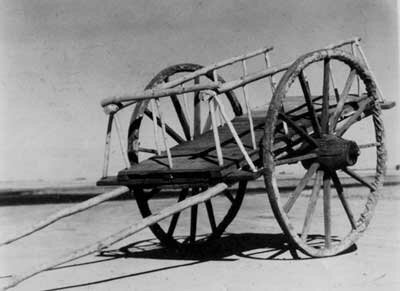
The Métis held huge buffalo hunts with Red River carts squeaking across the prairie to carry back tons of meat and hides. The Red River carts were based on French peasant carts. The wooden wheels were not greased because the prairie dust would stick to the oil and clog up the wheels, so they made a terrible squeaking noise that could be heard for miles. Hundreds of people went together to hunt buffalo, They were organized into camps, and had rules to follow that were strictly enforced so that no one could scare the buffalo away. When the signal was given, hundreds of men raced towards the buffalo. Each marked the buffalo he shot. At the end of the day, the men would retire to eat and discuss the hunt, while the women and children set to work skinning and cleaning the buffalo. They made pemmican from the buffalo meat by drying the meat, pounding it, then mixing it with fat and stuffing it into a bag made of animal skin or intestine. The Métis sold pemmican to both companies. |
|||
| Back to the Top | ||||
| Copyright Goldi Productions Ltd. 2007 | ||||
|