| The Battle of Cut knife | |||||||||||
| A Great Canadian Prevents a Massacre | |||||||||||
| Col. William Otter's troops had left the railway and marched north to Battleford which had been raided by Pounmaker's Cree looking for food. After reaching the town he marched on the Cut Knife Reserve hoping to put a damper on local unrest with a show of force. | |||||||||||
|
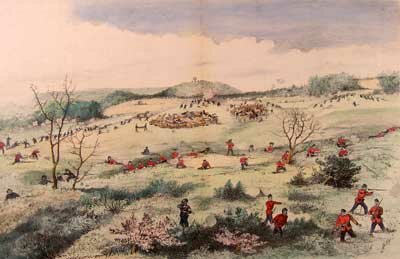
Cut Knife: The battle took place on May 2, 1885, on a hill above the Cut Knife Reserve, headed by Chief Poundmaker. His band had recently raided stores and homes near Battleford for provisions and equipment. Col. William Otter, and his Battleford Column of the North West Field Force, fearing that the lawlessness would escalate, marched on the reserve to restore order. He has 325 men - only 50 are mounted - some 48 wagons, 2 muzzle-loading artillery pieces, and a Gatling Gun.
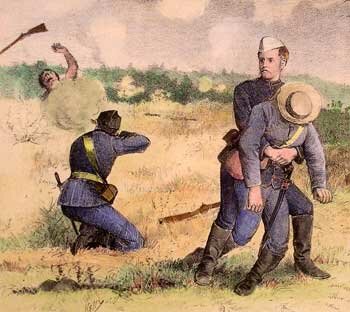
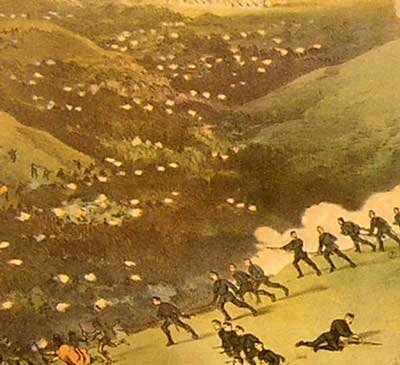
The artillery guns are useful at first, then break down, and the Gatling Gun's range is too short to be effective, and difficult to use against Indians who refuse to come out in the open. By noon, realizing the exposed and hopeless position of his men, and having nightmares of a repeat of Custer's Last Stand, only nine years before, Otter retreats with his men, under a heavy sniper fire. Their rear is protected by the rapid firing of Arthur Howard's Gatling Gun which persuades the Indians to stay a healthy distance away.The Indians do not pursue. Otter has lost eight men; the Indians six. Nothing is resolved. |
||||||||||
 |
|||||||||||
|
|
|||||||||||
|
To please the home crowd - and its principal market for the print - Blatchly gives the Toronto-based Queen's Own Rifles pride of place at the front of the picture, and shows them heroically putting the fear of God into the Indians! You can almost hear breast buttons popping with pride on Armoury Street in Toronto. The truth was rather the reverse. The Indians were still there that evening; the Queen's Own were long gone from the site. But Blatchly does mention the Gatling Gun this time - in the key at the bottom of the page - but he only shows it indistinctly, in the far distance with the other guns in front of Otter. And quite incorrectly at that - surrounded by a group of operators!!! Or is it the one belching a huge cloud of smoke?
|
|||||||||||
|
|||||||||||
| Back to the Top | |||||||||||
| Copyright Goldi Productions Ltd. 2007 | |||||||||||
|
 Great Canadian Heritage Treasure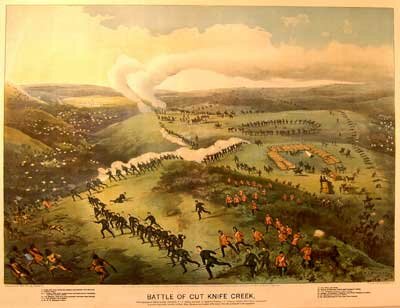
 After marching 35 miles in freezing rain, a night out with no sleep, and nourished only on packed rations, the column reaches Cut Knife Hill, overlooking the Indian camp. The Indians hide in the brush-filled coulees that criss-cross the hill and fire from cover at Otter's men out on the open hilltop.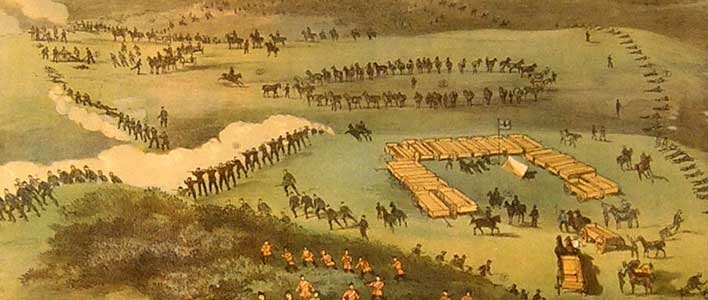
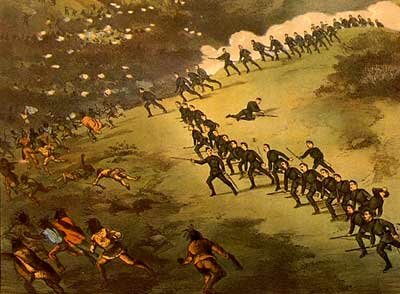 Otter's Last Stand: At the centre of his litho, Blatchly shows Col. Otter mounted, directing the battle, on the hill at top left. The print wonderfully captures the exposed nature of Otter's position, surrounded on all sides by hostile fire, coming from an unseen enemy, hiding in the brush, and only identified by puffs of smoke. Blatchly shows that there was no cover for the horse corral, or the wagon park with its Red Cross ambulance station. He shows exactly the right number of horses that were there, but is mysteriously missing half the contingent's wagons! With artistic license you can hear him say "There's just too damn many wagons! Half is good enough."
 Go to Blatchly